

Cable faults
Fault location on underfloor heating and thin-bed heating mats in Bavaria and Baden-Württemberg
An electric underfloor heating that stays cold presents an unpleasant bill: the fault lies somewhere under the finished floor – and the floor is glued, grouted, paid for. Opening on suspicion means sacrificing tiles. CFT locates the fault from above, marks it on the floor covering and hands over the report for electrician and insurer: one tile instead of one floor. Reach us on +49 (0) 173 6842932 or at office@cft-de.de.

What we do on site
On the isolated heating circuit, insulation and resistance measurements show whether the heating conductor is broken or shorting against the protective braid. Time domain reflectometry gives the distance in the conductor; heated up via the generator, the thermal imaging camera shows route and fault position on top of the floor covering. Opening and repair are done by your electrician – at one marked spot.
Key facts at a glance
| Methods | Insulation and resistance measurement, Time domain reflectometry (TDR), Burn-down generator for heating up, Sheath fault location, Thermography |
|---|---|
| Application range | Electric underfloor, wall and ceiling heating in living spaces; thin-bed heating mats under tiles, heating cables in screed and floor build-up |
| Duration | Two hours to one day, depending on the number of faults |
| Result format | Damage report as a PDF |
| Service area | Bavaria and Baden-Württemberg from our Erding base – CFT Group Deutschland GmbH, Lange Zeile 27, D-85435 Erding |
What this means for you
The difference between a located and a suspected fault is bigger with heating mats than anywhere else: the mat lies in loops under the whole room, and every opened spot that is not the right one damages the floor permanently. With location, the repair becomes a small matter – one marked spot, one tile, one joint in the heating conductor. The report counts for the insurer too: it records fault type and position before anything is opened.
How the job runs
- You report the heating circuit; isolation happens at the thermostat – we agree that with you or your electrician.
- Insulation and resistance measurements determine the fault type: break, or short against the protective braid.
- Time domain reflectometry gives the distance within the heating conductor.
- The generator heats the circuit in a controlled way; the thermal imaging camera shows route and fault position on top of the covering – that is where we mark.
- You receive the damage report as a PDF for electrician and insurer.
Equipment and methods
The combination is what makes the location precise: electrical measurements say WHAT is broken and how far along the conductor it lies; thermography translates that into a point on the floor covering. That the route of the whole mat becomes visible helps twice over – the electrician sees where to cut without hitting the neighbouring loop.

What you receive
The marked fault position on the floor covering and a damage report as a PDF with fault type, readings and position. Your electrician can open and repair precisely – and your insurer has a solid basis.
We show what we find.
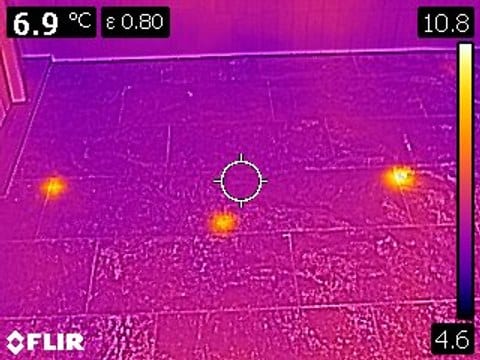
The same spot, photographed twice: on the left the floor as you see it – on the right what the thermal imaging camera sees once the heating is powered.
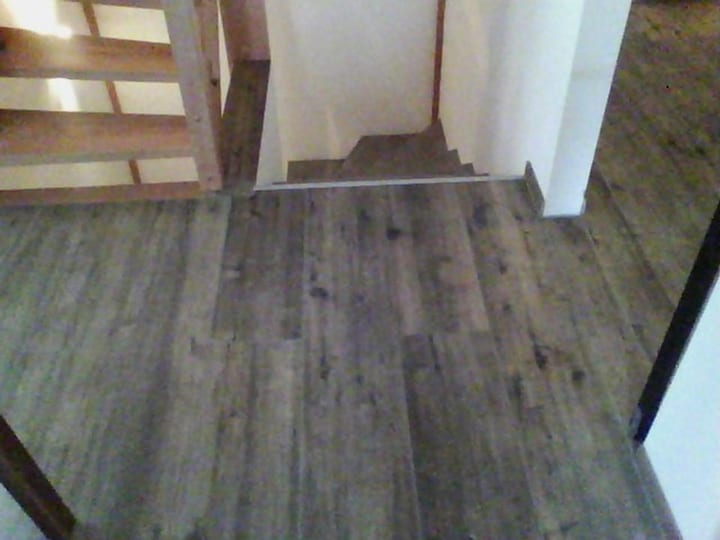

A floor gives nothing away. Under power the heated area shows itself within minutes – and a fault would stay dark.
And the fault itself – drag the edge: under the unremarkable tiles the marked find points light up.

Costs and effort
We charge per deployment from Erding. We tell you on the phone what the job will cost before you place the order – no surprises on the invoice.
Frequently asked questions
Does the location work under every floor covering?
Under tiles, screed and most coverings, yes. Strongly insulating build-ups – thick carpets, multi-layer old coverings – slow the thermal image down; heating up then takes longer but usually still works. We tell you honestly on the phone.
The heating works, but the RCD trips – is that the same fault?
That is typically an insulation fault against the protective braid – exactly what the first measurement shows. Such faults can be located and repaired locally too; the mat does not have to come out for it.
Can the mat stay in service after the repair?
Usually yes: heating conductors can be professionally jointed at the fault position. Whether that is worthwhile at the age and condition of your mat becomes clear after the measurement – the report provides the basis for the decision.
Describe what you are observing.
Just describe what you see – add a photo, and we can often settle on the right method before we even call back.
What happens next
- We read your message and match the case to a method.
- We come back to you – usually with a question that shortens the appointment.
- We confirm the appointment and what it costs before anyone sets off.
Rather talk?
+49 (0) 173 6842932
Describe your case.
Fastest by telephone – then we settle straight away which method fits and what you should prepare.
Or write to office@cft-de.de.