

Locating and surveying · Slabs and structures
Locating concrete core activation in Bavaria and Baden-Württemberg
Concrete core activation turns the slab into a heating system – and every core drilling into a risk: the water-bearing pipe loops sit tightly in the concrete, and a single hit shuts down the circuit and, at worst, floods the floor below. CFT locates the pipe runs with ground penetrating radar, marks them on the structure and defines the free drilling windows. Call +49 (0) 173 6842932 or write to office@cft-de.de.

What we do on site
We survey the slab or floor area with ground penetrating radar on a grid, evaluate the depth slices and mark the pipe runs on the structure. Drill and anchor points are placed in the free windows and documented – before the core drill starts, not after.
Key facts at a glance
| Methods | Ground penetrating radar (GPR) on the structure, Grid scan with depth slices, Marking of pipe runs and drilling windows, Documentation of the evaluation |
|---|---|
| Application range | Thermally activated slabs and floors; plus gas, water and electrical services, conduits and pipes of every kind in floor build-ups, slabs and walls – before core drilling, anchor fields and retrofits |
| Duration | Two hours to several days, depending on the area |
| Result format | Marking on the structure, Documentation as specified, as PDF |
| Service area | Bavaria and Baden-Württemberg from our Erding base – CFT Group Deutschland GmbH, Lange Zeile 27, D-85435 Erding |
For you as a business
With activated structures, drilling with or without a survey is not a comfort question but the difference between a routine job and a burst pipe in raw concrete: leakage, drying, chiselling and a heating circuit that needs a new joint – against a few marked runs and drill points placed between them. The documentation doubles as a documented drilling clearance for the project file.
How the job runs
- You name the area, the drill points and the schedule; layout drawings of the activation help but are not required.
- The area is surveyed on a grid with the radar – non-destructively, from whichever side is accessible.
- The depth slices show the pipe layers; the runs are marked on the structure.
- Drill and anchor points are placed in the free windows and photographed.
- You receive the documentation as a PDF – evaluation, marking, points.
Equipment and methods
The radar reads the reflections inside the concrete: heating loops, reinforcement and conduits show up as separate layers in the depth slices. The craft lies in the interpretation – telling reinforcement from a heating pipe takes experience with exactly these areas, and our crews survey them year in, year out. The structure itself is never touched.

What you receive
Marked pipe runs and cleared drilling windows directly on the structure, plus the documentation as a PDF. Your drilling crew works to the marking – not to hope.
We show what lies in the slab.
Three real jobs: the radar evaluation projected onto the floor area, the depth slice showing the heating loops – and the survey of a ceiling on video.
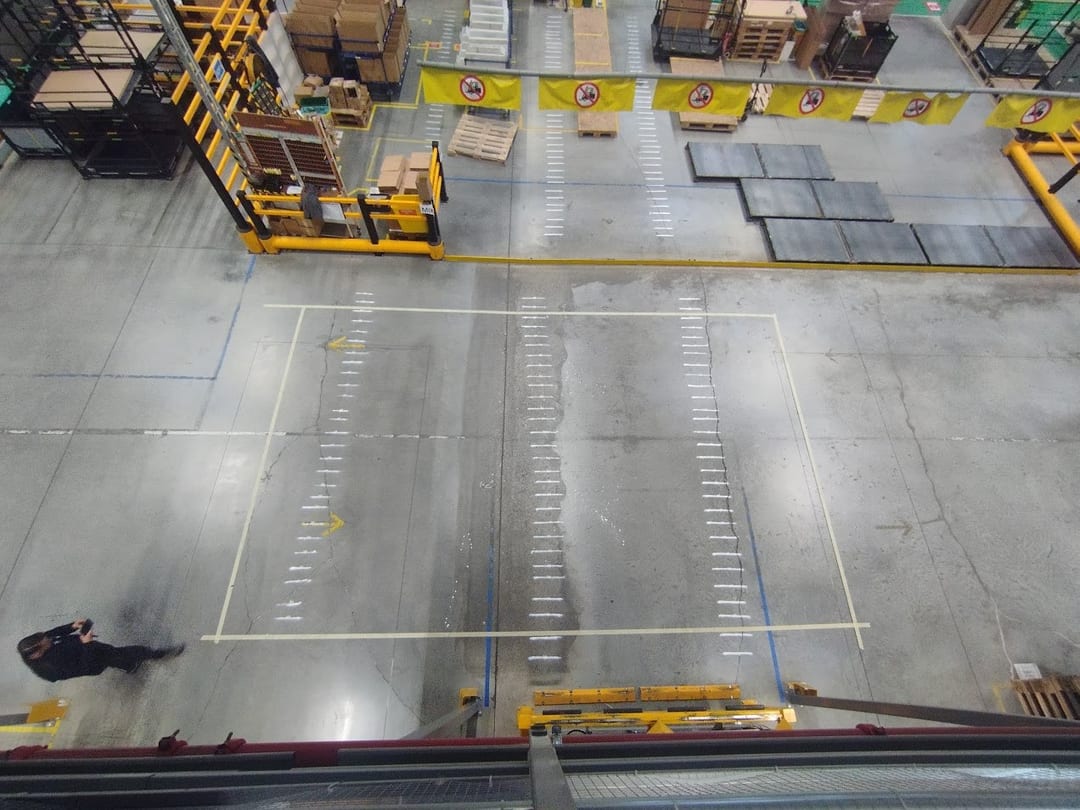
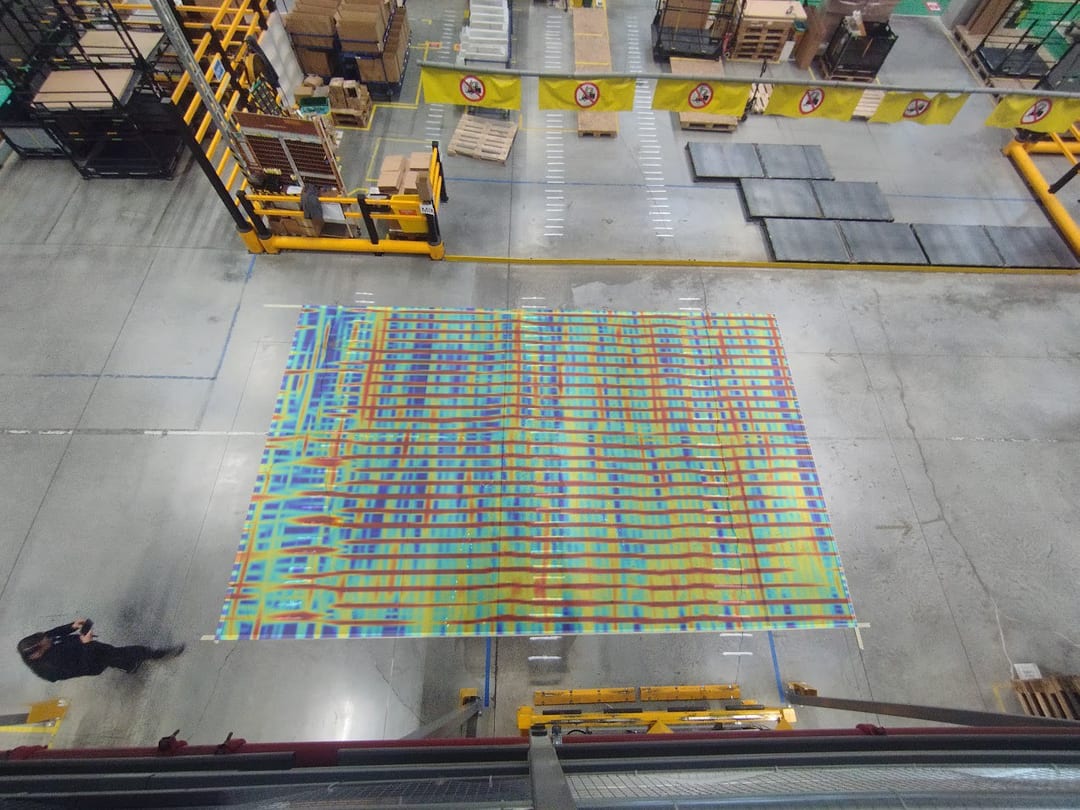
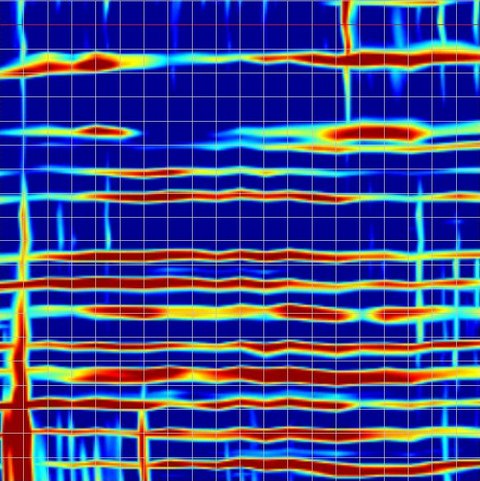
Drilling starts once the grid is on record: the loops are marked on the surface, the drill points placed between them.

Costs and effort
Charged by area and number of points from Erding. A survey costs a fraction of what a single hit pipe triggers in repairs, drying and downtime – we quote by phone once you name the area.
Frequently asked questions
How accurate are the marked runs?
Accurate enough for a drilling clearance: the runs are marked on the structure and the drill points placed in the free windows with a safety margin. Where it gets tight, we say so – and move the point rather than risk it.
Does the survey also work overhead, from below the slab?
Yes. We measure from whichever side is accessible – floor or ceiling. Overhead takes a little longer; the result is the same.
We have the layout drawings of the activation – is that not enough?
Drawings show the intention, the radar shows the as-built state: installed loops deviate from the plan, and the drill goes into the structure, not into the drawing. With drawings the survey is faster – replace it they cannot.
Related services
Foundation and embedded services survey
When the question is not the heating loop but foundations, voids and embedded structures.
Site and route clearance survey
For open ground before construction starts.
Heating mats and heating cables
For electric heating conductors beneath the covering, located with measuring current and thermal imaging instead of radar.
Describe the findings.
The more precisely you describe the findings, the more directly we can go to work. Plans, readings and photos help us settle the method in advance.
What happens next
- We read your message and match the case to a method.
- We come back to you – usually with a question that shortens the appointment.
- We confirm the appointment and what it costs before anyone sets off.
Rather talk?
+49 (0) 173 6842932
Describe your case.
Fastest by telephone – then we settle straight away which method fits and what you should prepare.
Or write to office@cft-de.de.